Skip to content




When you look at options for replacing missing teeth, you may see 3 on 6 dental implants and traditional dental implants listed side by side. Both use dental implants placed in your jaw, but they are built in very different ways.
Understanding those structural differences helps you choose the option that fits your mouth, health, and budget.
3 on 6 dental implants use six implants to support multiple connected crowns for a full-arch restoration, while traditional dental implants usually replace each missing tooth with its own separate implant and crown.
This design changes how your dentist places the implants, how your bite feels, and how your jawbone supports the final result.
If you want to know how implant placement, bone density, daily care, and long-term costs compare, you need a clear breakdown of how each system works. A closer look at these structural details will show you which approach may suit your needs.
Key Takeaways
- 3 on 6 implants support a full arch with six implants, while traditional implants replace teeth one by one.
- Implant design affects bone support, placement method, and daily function.
- Cost, healing time, and long-term maintenance can differ based on the structure you choose.
Table of Content
- Understanding the Fundamentals of 3 on 6 and Traditional Implants
- Structural Differences and Implant Placement Techniques
- Bone Health, Bone Density, and Jawbone Considerations
- Functionality, Maintenance, and Daily Experience
- Comparing Longevity, Cost, and Suitability for Different Patients
- Frequently Asked Questions
Understanding the Fundamentals of 3 on 6 and Traditional Implants
When you compare 3 on 6 dental implants and traditional dental implants, you are really comparing two different ways to support replacement teeth. Each option uses implants in your jawbone, but the structure and final result can look and feel different.
What Are 3 on 6 Dental Implants?
3 on 6 dental implants use six dental implants to support three separate dental bridges. Your dentist places the implants along your upper or lower jaw. Each pair of implants holds a bridge, which together forms a full-arch prosthesis.
This design spreads biting force across six dental implants instead of placing one implant for every missing tooth. You get a fixed, non-removable solution that stays in place like natural teeth.
Unlike some other full-mouth restoration methods, 3 on 6 often uses individual bridges rather than one solid piece. That can make cleaning easier and may allow simpler repairs if one section needs work.
You choose this option when you want a stable, long-term tooth replacement that feels secure.
How Traditional Dental Implants Work
Traditional dental implants replace teeth one at a time. Your dentist places a titanium post into the jawbone for each missing tooth. After healing, they attach an abutment and a crown on top.
The dental implant procedure usually takes place in stages. First comes implant placement. Then you wait several months for the bone to bond with the implant, a process known in implantology as osseointegration.
If you miss several teeth in different areas, your dentist may place multiple single implants. Each one acts like an artificial tooth root. This method works well when you have enough healthy bone and only a few missing teeth.
Overview of Full-Mouth and Full-Arch Restorations
When you lose most or all of your teeth, you may need a full-mouth restoration or a full-arch prosthesis. These treatments replace an entire row of teeth, not just one or two.
A full-arch restoration can use different systems. Options include traditional dental implants placed across the arch, removable dentures, or structured systems like 3 on 6. Each method supports your bite in a different way.
With 3 on 6, six dental implants anchor three bridges to form one complete arch. Other systems may use fewer implants to hold a single large prosthesis.
Clinics that focus on 3-on-6 dental implants explain how this design compares with other full-arch options. Your choice depends on bone density, budget, and how fixed you want your tooth replacement to feel.



Structural Differences and Implant Placement Techniques
The 3 on 6 system and traditional implants differ in how dentists place implants, attach bridges, and spread bite forces. These structural choices affect stability, repair options, and how your new teeth feel during daily use.
Bridge Design and Implant Distribution
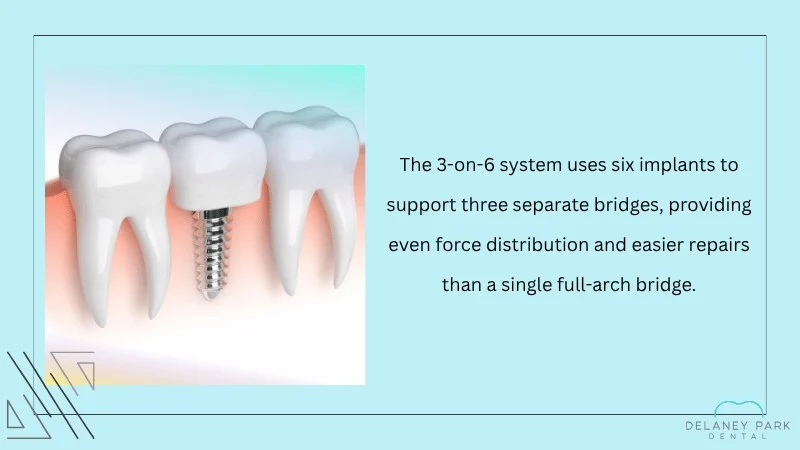
With 3 on 6 implants, your dentist places six dental implants in the upper or lower jaw. They then attach three segmented bridges, with each bridge supported by two implants.
This design divides your arch into sections instead of using one long bridge.
If one implant fails, it usually affects only one section, not the entire arch. This segmented layout can make repairs more manageable.
Traditional implants work differently. Your dentist often replaces each missing tooth with its own implant and crown. In full-arch cases, some systems use a single long bridge supported by fewer implants.
For example, the 3 on 6 dental implant technique connects three separate bridges to six implants across the arch.
Implant placement also differs. In a 3 on 6 system, your dentist spreads six titanium implants across the jaw to distribute pressure more evenly during chewing.
Materials Used: Zirconia, Acrylic, and Titanium
The materials used in your restoration affect strength, weight, and long-term wear.
Many 3 on 6 implants use zirconia bridges. Zirconia is a strong ceramic material that resists cracks and stains. It feels solid and closely resembles natural enamel in color.
Some full-arch systems use an acrylic bridge attached to a metal frame. Acrylic weighs less and costs less, but it can wear down faster over time. It may need replacement sooner than zirconia.
All systems rely on titanium implants placed into your jawbone. Titanium bonds well with bone and has a long history of safe use in implant surgery. The difference lies more in the bridge material than in the implant screw itself.
Abutment Connections and Osseointegration
After implant surgery, your jawbone must fuse with the titanium surface. This process, called osseointegration, creates a stable base for chewing.
Once healing occurs, your dentist attaches an abutment to each implant. The abutment acts as a connector between the implant and the bridge or crown.
In a 3 on 6 system, each of the six dental implants receives its own abutment. The three segmented bridges then attach over these abutments. This setup allows each section to function independently.
With traditional single-tooth implants, one abutment supports one crown. In full-arch designs that use one long bridge, multiple abutments connect to a single structure.
The way these parts connect affects how force moves through your jaw and how easily your dentist can remove or repair the prosthetic if needed.
Bone Health, Bone Density, and Jawbone Considerations
Your jawbone must support each implant with enough strength and volume to keep it stable. Bone density, bone loss, and the condition of your posterior maxilla all affect how well 3 on 6 and traditional implants perform over time.
Bone Preservation and Bone Loss Prevention
When you lose a tooth, your jawbone no longer receives pressure from chewing. That lack of pressure can lead to bone loss over time.
Dental implants help reduce this problem because they transfer chewing forces into your jawbone.
Research on dental implants and their impact on bone health, including jawbone density and structure, shows that implants can support bone preservation and may help maintain local bone density.
With a 3 on 6 system, six implants spread biting forces across the arch. This wider distribution can support jawbone health by limiting stress on any one area.
Traditional single implants also protect bone, but each implant stands alone. If you lose one implant due to infection or implant failure, that area can lose support again.
You protect your bone by:
- Keeping gum tissue healthy
- Treating infection early
- Following regular dental checkups
Healthy bone around implants lowers the risk of future bone loss.
Dealing With Bone Loss and Bone Grafting
Not everyone has enough bone volume for implants at the start. Dentists measure both bone quantity and bone density before planning treatment. Bone quality plays a key role in implant stability.
If your jawbone lacks height or width, you may need bone grafting. During this procedure, your dentist adds bone material to rebuild the area.
Bone grafting can:
- Increase bone thickness
- Improve implant stability
- Reduce the risk of implant failure
For 3 on 6 implants, strong bone at six planned sites is important. If several areas show bone loss, treatment may take longer because you must rebuild multiple spots before placing implants.
Traditional implants may require grafting at each missing tooth site. The total amount of grafting depends on how many teeth you lost and how long ago you lost them.
Posterior Maxilla and Its Challenges
The posterior maxilla is the back part of your upper jaw. This area often has lower bone density than the lower jaw.
It also sits close to the sinus cavity. Limited bone height can make implant placement more complex.
The differences in density between upper and lower jaws affect implant length and type. In the posterior maxilla, you may need:
- A sinus lift
- Shorter or angled implants
- Bone grafting
For 3 on 6 implants in the upper arch, your dentist must confirm that the back implant sites have enough density to anchor securely. Weak bone in this region increases the risk of implant failure if not treated correctly.
Careful imaging and planning protect your jawbone and improve long-term stability.
Functionality, Maintenance, and Daily Experience
Your choice affects how you chew, how you clean your teeth, and how your teeth feel each day. These details shape your comfort, diet, and daily routine.
Chewing Ability and Chewing Function
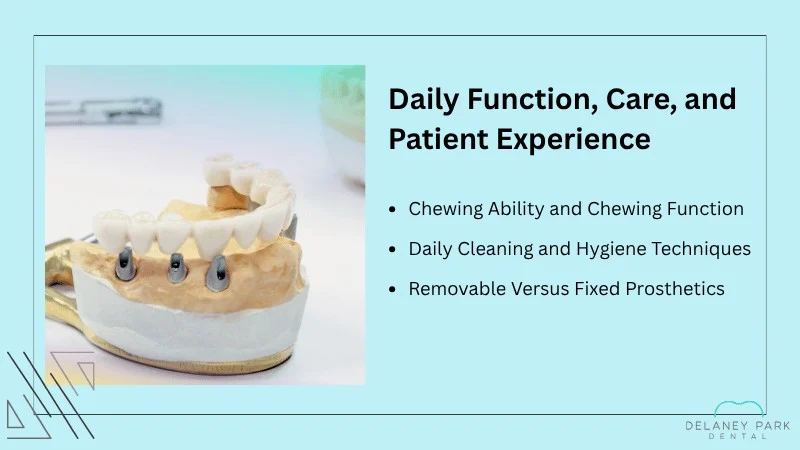
With 3 on 6 implants, you chew using several implant-supported dental bridges that sit across the arch. Each bridge connects to two implants, which helps spread bite force more evenly.
You can usually eat firmer foods like meat or raw vegetables with more confidence than with traditional dentures. The implants anchor the bridges in place, so they do not shift while you chew.
Traditional implants placed one per tooth also support strong chewing function. They act much like natural tooth roots and allow you to bite with precision.
In contrast, removable dentures rest on your gums. They may move during meals and limit your chewing ability, especially with sticky or hard foods.
Chewing performance depends on bone support, bite design, and healing. If implant failure occurs, your dentist must treat the area, which can affect function until repaired.
Daily Cleaning and Hygiene Techniques
You must clean 3 on 6 implants carefully each day. Food can collect under the bridges and around the gumline.
Most Anchorage dentists suggest:
- A soft toothbrush
- Floss threaders or super floss
- A water flosser to flush debris under the bridges
A water flosser often makes it easier to reach under fixed dental bridges. You aim the stream along the gumline and beneath the prosthetic teeth to reduce plaque buildup.
Traditional single implants require brushing and flossing just like natural teeth. You clean between each implant crown with regular floss or small interdental brushes.
Removable dentures need a different routine. You take them out at night, brush them outside your mouth, and soak them. You also clean your gums to lower the risk of irritation.
Good hygiene lowers the risk of infection and helps prevent implant failure.
Removable Versus Fixed Prosthetics
3 on 6 implants use fixed bridges. Your dentist secures them to implants, and you do not remove them at home.
This fixed design often feels more stable than removable dentures. You speak and chew without worrying about slipping or adhesives.
Traditional implants also support fixed crowns. Each crown stays attached to its own implant, which gives a very natural feel.
Removable dentures sit on the gums and may use suction or clips. You remove them daily for cleaning. Some people prefer this option because it costs less at first, but it may not feel as secure.
When choosing between fixed and removable prosthetics, think about stability, cleaning time, long-term maintenance, and how much daily handling you want.
Comparing Longevity, Cost, and Suitability for Different Patients
When you compare 3 on 6 implants with traditional implants, you need to look at how long they last, what you pay, and whether your mouth can support them. Your bone level, budget, and long-term goals will guide your choice.
Durability and Longevity Expectations
Both systems can last many years when your dentist places them well and you care for them properly. A traditional single implant can often last 20 years or more. The crown on top may need replacement sooner due to wear.
A 3 on 6 dental implant supports a full arch restoration with six implants and three bridges. This design spreads bite force across more anchors. Even pressure can lower the risk of overload and implant failure.
If one bridge wears out, your dentist can often replace that section without removing the entire arch. In contrast, some full-arch systems like all-on-4 use one larger prosthesis, so damage may affect the whole unit.
Your daily habits matter just as much as design. Smoking, gum disease, and poor brushing increase the risk of implant failure in both options.
Cost of 3 on 6 Versus Traditional Implants
The cost of 3 on 6 is usually higher upfront than replacing teeth one by one. You pay for six implants and multiple connected bridges in a single arch.
Reports show the average cost per arch often falls in the tens of thousands of dollars, depending on location and materials.
Traditional implants charge per tooth. If you replace only one or two teeth, that route often costs less. But if you need a full arch restoration, placing many single implants can exceed the price of a 3 on 6 or even an all on 4 system.
You should also factor in maintenance. Sectioned bridges in 3 on 6 may reduce future repair costs because your dentist can fix one part instead of the entire arch.
Who Makes a Good Candidate?
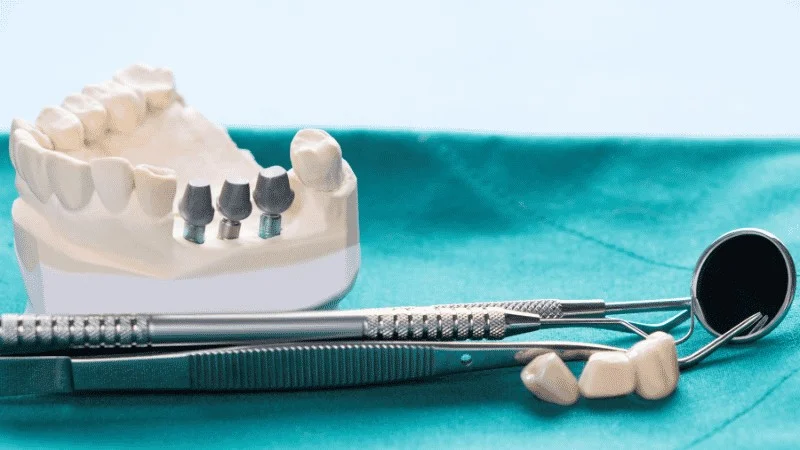
You make a strong candidate for 3 on 6 if you miss most or all teeth in one arch and want a fixed solution. Dentists look for solid bone density and healthy gums before placing six implants.
Clinics often explain that candidacy depends on bone quality, oral health, and treatment goals, as described in this overview of 3 on 6 dental implant suitability.
If you have severe bone loss, your dentist may suggest bone grafting or consider all-on-4 instead.
Traditional implants suit you best when you miss only a few teeth and still have healthy surrounding teeth. You keep more flexibility because each implant stands alone.
Your dentist will use 3D scans and a full exam to decide which option supports your bite safely and lowers your risk of implant failure over time.
Frequently Asked Questions
When you compare 3-on-6 and traditional implants, you look at how many implants support the teeth, how the bridge connects, and how chewing forces move through the jaw. Cost, comfort, and stability also depend on these structural choices.
What’s the main structural difference between a 3-on-6 implant bridge and a traditional implant approach?
In a 3-on-6 setup, your dentist places six implants in one arch and attaches three separate bridges on top of them. Each bridge usually connects to two implants, which creates segmented support across your jaw.
With traditional implants, you often replace each missing tooth with its own implant and crown. Every implant stands alone instead of being joined in a multi-unit bridge.
That means 3-on-6 links implants together in sections, while traditional implants keep each tooth replacement independent.
How do All-on-4, All-on-6, and 3-on-6 compare in terms of stability and support?
All-on-4 uses four implants to hold a full arch bridge. The back implants often tilt to increase contact with available bone.
All-on-6 uses six implants under one fixed bridge. This adds two more anchors compared to All-on-4, which may improve support in some cases.
3-on-6 also uses six implants, but it divides the teeth into three bridges instead of one long bridge. The main structural change is whether your teeth sit on one large bridge or several smaller ones.
How many implants are typically needed with traditional implants compared to 3-on-6?
With traditional implants, you usually need one implant per missing tooth. If you miss ten teeth, you may need close to ten implants, depending on spacing and bone.
With 3-on-6, you receive six implants to support an entire arch. The bridges connect to those six anchors instead of placing an implant for every tooth.
How does the load distribution differ between 3-on-6 and traditional implants?
In a traditional setup, each implant absorbs force from its own crown. When you chew, pressure transfers directly from that tooth into the single implant below it.
In a 3-on-6 design, each bridge spreads chewing forces across two implants. The six implants work together across the arch, which can help balance pressure from side to side.
This shared support changes how force moves through your jawbone. Instead of isolated pressure points, you get grouped load sharing within each bridge segment.
What are the typical cost differences between 3-on-6 and All-on-4 or All-on-6 options?
Costs vary based on how many implants you need, the materials used, and whether treatment covers one or both arches. A full arch solution often costs more than replacing a few single teeth.
Because 3-on-6 and All-on-6 both use six implants, their base surgical costs may look similar. All-on-4 may cost less in some cases because it uses fewer implants, but design and materials also affect the final number.
What do patient reviews commonly say about comfort and chewing performance with 3-on-6?
Many patients report that fixed full-arch options feel more stable than removable dentures. Because the bridges attach to implants, your teeth do not shift during meals.
Some reviews mention that chewing feels more natural once healing is complete. The segmented bridge design may also make cleaning easier compared to one long bridge.
Your comfort still depends on fit, bite alignment, and healing. Proper planning and follow-up visits play a big role in how your new teeth feel day to day.