Skip to content




If you have thin or weakening bones, you may wonder whether losing a tooth means living with the gap. It’s a fair question, since implants rely on your jawbone to hold them in place.
The good news is that dental implants with osteoporosis are often still possible. Dental implants are a safe and effective tooth replacement option for many people.
Osteoporosis is not considered a contraindication for placing dental implants, though your care team may adjust the plan and take a bit more time with healing.
Bone medications add another layer to think about. Drugs like alendronate change how your bone rebuilds itself, so your dentist will want to know how long you’ve been taking the medication and at what dose.
Below, you’ll learn how bone health shapes implant planning, what tests and options may come up, and simple steps that support healing for the long run.
Key Takeaways
- Many people with osteoporosis can still replace missing teeth with dental implants after careful planning.
- Your dentist reviews your bone quality, medications, and imaging before deciding on the best approach.
- Good aftercare and regular checkups help your implants stay healthy for years.
When Implants May Still Be an Option
Having osteoporosis does not automatically rule out dental implants. Many people with reduced bone density move forward with treatment once their dentist reviews their jawbone, medications, and overall health.
Why Osteoporosis Alone Is Not an Automatic Disqualifier
Osteoporosis affects your whole skeleton, but your jawbone may still have enough volume and quality to hold an implant.
There is also no set cutoff that says a certain amount of bone loss is too much. Instead, your dentist looks at your specific case.
That means many older adults and postmenopausal women are still good candidates.
Age itself does not necessarily prevent treatment, and many patients considering dental implants after 60 may still qualify after their bone and overall health are evaluated.
Careful planning matters more than the diagnosis, especially when your condition is well managed.
Osteoporosis is only one part of the evaluation, and several other factors determine whether you’re a good candidate for dental implants.
How Dental Implants Replace Missing Teeth
A dental implant is a small post, usually titanium or zirconium oxide, that acts as an artificial tooth root.
An oral surgeon places the post into your jawbone. Over the next several months, bone grows around it and locks it in place. This process is called osseointegration, and it creates the stable base your new tooth needs.
Once the bone has healed, your dentist attaches an abutment and then a crown, bridge, or denture on top.
The result looks and works much like a natural tooth. Unlike a removable denture, the implant stays put and helps preserve the bone around it.
What Implant Success Depends On
Your overall health can affect how your body responds to treatment, which is why understanding the connection between overall health and dental implants is an important part of planning.
Dental implant success rests on a handful of factors your dental team will check before surgery:
| Factor | Why It Matters |
| Bone volume and density | Thin or soft bone reduces implant stability and raises the chance of implant failure |
| Gum health | Active gum disease must be treated first before implants are placed |
| Medications | Bisphosphonates and other bone drugs need review, especially IV forms |
| Imaging and scans | CT and DEXA results guide how much bone volume you have |
| Home care and follow-up | Daily brushing, flossing, and checkups protect long-term implant survival |
If your bone is too thin, a graft can build it up first. Up to half of all implant surgeries include some form of bone grafting, so it is a common step rather than a setback.
Smoking and uncontrolled diabetes also slow healing, so your dentist will talk through those with you.
How Bone Health Affects Implant Planning
An implant needs enough bone around it to stay steady, so your dentist looks closely at how much bone you have, how strong it is, and why any of it may be missing.
Osteoporosis, hormone changes, gum disease, and missing teeth can each change the plan.

Bone Density, Bone Volume, and Bone Quality
Three different things matter when your dentist checks your jaw, and they are easy to mix up.
- Bone volume is the amount of bone; its height and width at the implant site.
- Bone density (or bone mineral density) is how tightly packed the minerals in that bone are.
- Bone quality describes the structure, including how thick the outer shell is and how the inner trabecular bone is arranged.
You can have plenty of bone volume but softer, low-density bone, or dense bone in a spot that is too narrow.
A cone beam CT scan lets your dentist measure all three before surgery. Reviewing your bone density for dental implants helps decide implant length, width, and how long healing should take.
How Osteoporosis Can Affect the Jawbone
Osteoporosis happens when bone breaks down faster than your body rebuilds it. Cells called osteoclasts remove old bone, and when bone turnover tips in their favor, bone becomes thinner and weaker.
Falling estrogen levels after menopause are a common reason bone metabolism shifts this way. An osteoporosis diagnosis usually comes from a DEXA scan of your hip and spine, not your mouth.
Still, lower density can show up in the jaw. That is why your dentist may choose a wider implant or wait longer before attaching the tooth.
Other Causes of Jawbone Loss
Osteoporosis is not the only reason the jawbone shrinks, and often it isn’t the main one.
Gum disease is a frequent cause. Advanced periodontitis destroys the bone that holds teeth in place, and that damage stays after the tooth is gone.
Tooth loss itself can contribute to bone changes over time, which is one reason leaving a missing tooth untreated can create additional oral health concerns.
Other causes include long-term denture wear, past injuries, infections, and cysts.
Your dentist sorts out which of these applies, since bone health and medications both shape the treatment plan. Grafting can rebuild missing bone, and roughly half of implant surgeries include some type of graft.
Bone Medications and Surgical Risks
The medicine you take for bone loss matters more to your implant plan than the osteoporosis diagnosis itself.
Pill-based drugs, injections, and IV infusions each carry different timing rules and a different (though small) chance of healing problems.
Bisphosphonates, Fosamax, and Reclast
Bisphosphonates are the most common osteoporosis medications. They slow down the cells that break down bone, which helps prevent fractures.
You may take one as a pill, like Fosamax (alendronate), Actonel (risedronate), or Boniva (ibandronate). Others are given by IV, like Reclast (zoledronic acid).
Here’s the good news: research on bisphosphonates and dental implants suggests these drugs don’t meaningfully raise implant failure rates.
One review estimated 509 implants would need to be exposed to the drugs to cause a single extra failure.
Risk does shift a bit based on how you take the drug:
| Type | Examples | Relative concern |
| Oral, low dose | Fosamax, Actonel, Boniva | Very low |
| IV, low dose (osteoporosis) | Reclast | Low |
| IV, high dose (cancer care) | Zometa, Aredia | Higher |
The main caution is length of use. Taking oral bisphosphonates for more than four years puts you in a group your dentist will watch more closely, though serious complications remain rare at osteoporosis dosing.
Denosumab and Prolia Considerations
Denosumab, sold as Prolia, works differently. It’s a shot you get under the skin once every six months, and it blocks a protein that osteoclasts need to mature.
Unlike bisphosphonates, denosumab doesn’t stick around in your bone for years. Its effect fades by about the six-month mark, which gives your dental team a helpful planning window.
That’s why many clinicians schedule implant surgery near the end of a dosing cycle. Some suggest the best window is a few weeks before your next Prolia injection, roughly five to six months after the last one.
Keep in mind that research on denosumab and implants is still limited compared to bisphosphonates. Your dentist will likely rely on timing and careful surgical technique rather than firm long-term data.
Understanding the Rare Risk of ONJ
Osteonecrosis of the jaw (ONJ) is the complication people worry about most. It means an area of the jawbone becomes exposed and doesn’t heal on its own within eight weeks, often with pain or swelling.
It’s uncommon. For people on bisphosphonates for osteoporosis, reported rates run between 0.001% and 0.01%, rising toward 0.2% after more than four years of treatment.
Certain things raise your odds:
- Smoking
- Corticosteroids taken long term
- Diabetes
- Untreated gum disease
- Poorly fitting dentures that rub the gums
- Longer time on antiresorptive therapy
Your surgeon can lower the risk with gentle technique, plenty of irrigation while drilling, and stitches that fully close the gum tissue.
Good dental implant planning around osteoporosis starts with treating any gum problems first.
Why Medication Changes Require Physician Guidance
Never stop your bone medication on your own. Skipping doses raises your fracture risk, and a broken hip is a far bigger problem than delayed healing in your jaw.
Antiresorptive therapy usually doesn’t need to be stopped before implant placement. A “drug holiday” is sometimes discussed after four or more years of use, but only your prescribing doctor can make that call.
Bring your full medication history to your consultation. List the drug name, the dose, how you take it, and how long you’ve been on it.
Your dentist and your physician should talk directly. That teamwork is a big part of keeping implants safe while you manage bone health, since each of them sees only part of the picture.
Your Implant Evaluation and Treatment Options
Before anyone drills into bone, your dental team needs a clear picture of your jaw, your medications, and your healing capacity.
From there, you may hear about bone grafting, smart implant placement, smaller implants, or non-surgical ways to replace missing teeth.
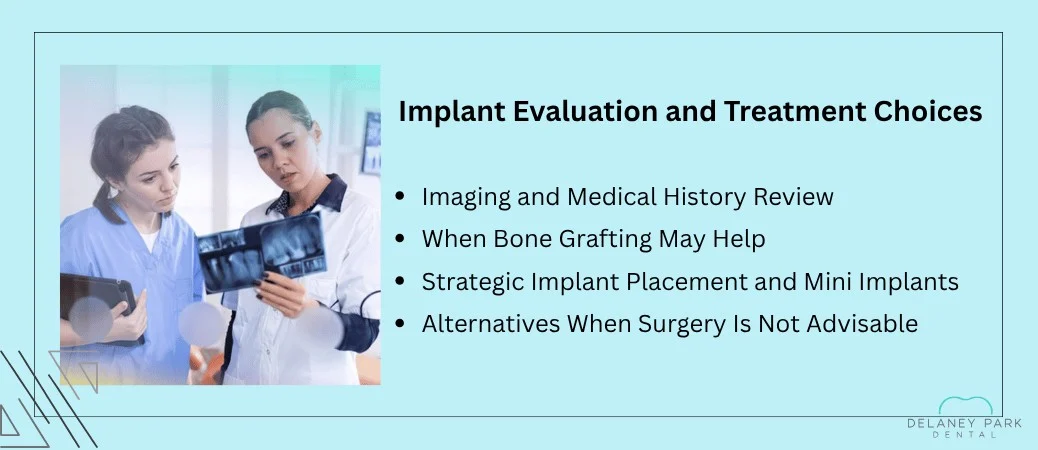
Imaging and Medical History Review
Your evaluation usually starts with a 3D scan, called a CBCT, plus a panoramic X-ray. These show how much bone height and width you have, and how dense that bone looks.
Dentists sometimes measure bone density in Hounsfield units, and quantitative computed tomography remains the most reliable way to check jaw density before surgery. There is no DXA scan made for jaws.
Your health history matters just as much. Bring this list to your visit:
- Your DXA T-score and when you were diagnosed
- Every bone medication, including alendronate (Fosamax), risedronate, zoledronic acid, and denosumab (Prolia)
- How long you have taken it, and whether it was oral or by IV or injection
- Other risk factors: smoking, diabetes, steroid use, low vitamin D or calcium
Your dentist and your doctor may talk directly, since medications and bone health both shape the plan.
When Bone Grafting May Help
If your scan shows thin or short bone, a bone graft can rebuild the site so an implant has something solid to hold onto.
Common options include a socket graft right after an extraction, a ridge augmentation to widen narrow bone, and a sinus lift to add height in the upper back jaw.
Graft material may come from your own body, a donor, an animal source, or a synthetic product. Bone regeneration takes time, so you may wait four to nine months before implant placement.
One honest caveat: there is very little research on how safe or successful grafting is while you are taking antiresorptive drugs.
Ask your oral surgeon what evidence supports your specific plan, and what the backup option is if the graft does not take.
Strategic Implant Placement and Mini Implants
Sometimes the answer is not more bone, but better positioning. Dentists often treat osteoporotic bone as soft, porous bone, which changes how they work.
Practical adjustments you might hear about:
| Approach | Why it helps |
| Placing implants in denser areas, like the front lower jaw | Better initial grip |
| Wider or longer implants | More surface contact with bone |
| Gentle drilling with lots of irrigation | Less surgical trauma |
| Longer healing before the abutment and crown go on | More time to fuse with bone |
| Skipping immediate loading | Avoids stress on a weak connection |
Mini dental implants are narrower than standard ones and need less bone width. They are used most often to snap in a lower denture, not to support a single heavy molar crown.
Your surgeon may also check stability with insertion torque readings before adding the final teeth.
Alternatives When Surgery Is Not Advisable
Implants are not the only way forward, and waiting is a real choice. If you recently had a Prolia injection, your team may schedule surgery near the end of the six-month cycle, since that drug’s effect fades after about six months.
Other options that skip implant surgery:
- Removable dentures, full or partial
- Dental bridges, which use neighboring teeth for support
- Implant-supported dentures later, once your bone health or medication schedule allows
Even if implants are off the table today, other tooth replacement methods can still restore chewing and appearance.
If you do get implants, plan on regular checkups. People with osteoporosis may face more peri-implant bone loss over time, so cleanings and monitoring protect your investment.
Supporting Healing and Long-Term Implant Health
Your daily habits play a big role in how well an implant heals and how long it lasts.
Clean teeth and gums, avoiding smoking, getting enough vitamin D, and keeping up with checkups all help protect bone healing and implant stability.
Oral Hygiene Before and After Treatment

Good oral hygiene starts before surgery, not after. Many dentists ask you to treat gum disease and cavities first, since infection and inflammation can slow bone healing.
Your dentist may also recommend a professional cleaning shortly before the implant is placed.
After surgery, follow your dentist’s specific instructions. In most cases, that means:
- Rinsing gently with salt water or a prescribed antimicrobial rinse
- Brushing carefully around the surgical site with a soft brush
- Skipping the water flosser near the site until your dentist says it’s fine
- Cleaning daily around the crown once healing is complete, using floss, small interdental brushes, or a soft pick
Plaque buildup around an implant can lead to peri-implantitis, which causes bone loss around the post.
Poor dental hygiene is also listed among the risk factors that raise the chance of osteonecrosis of the jaw in people taking antiresorptive drugs, along with poorly fitting dentures and periodontitis.
Smoking, Nutrition, and Vitamin D
Smoking reduces blood flow to the gums and jawbone, which makes healing slower and raises the risk of implant failure.
Quitting, even a few weeks before and after surgery, gives your bone a better chance to bond with the implant.
Nutrition matters too. Low levels of vitamin D and calcium can affect bone metabolism, so your dentist may ask about your intake or suggest bloodwork before planning treatment.
A few simple habits that support bone healing:
| Habit | Why it helps |
| Stop or cut back on smoking | Improves blood supply and tissue repair |
| Limit heavy alcohol use | Alcohol abuse is linked to lower bone density |
| Get enough calcium and vitamin D | Supports bone formation around the implant |
| Manage diabetes and blood sugar | Diabetes affects bone tissue and healing |
Keep your physician in the loop, since your osteoporosis treatment plan and your dental plan should work together.
Follow-Up Care and Warning Signs to Report
Plan on more frequent checkups than average. Because osteoporotic bone is often softer and more porous, your dentist may allow a longer healing period before attaching the crown and may check implant stability before loading it.
Regular visits let your dental team spot small changes in gum health or bone levels through exams and X-rays. That early attention protects long-term dental implant success and implant survival.
Regular professional care and good home hygiene are important parts of long-term dental implant maintenance, especially when your dentist wants to monitor changes in the surrounding bone.
Call your dentist promptly if you notice:
- Pain or swelling that gets worse after the first week
- Exposed bone or an area that hasn’t healed after several weeks
- Gum bleeding, pus, or a bad taste near the implant
- Numbness in the jaw or lip
- An implant or crown that feels loose
These signs don’t always mean something serious, but a medication history review and quick exam help your dentist address problems while they’re still easy to treat.
Frequently Asked Questions
Osteoporosis by itself rarely rules out dental implants, but your medications, jawbone density, and medical history all shape the plan your dentist builds. Below are answers to the questions people ask most often before starting treatment.
Are dental implants safe for people with osteoporosis?
Yes, in most cases. Osteoporosis did not lead to higher implant failure rates, though patients did show more bone loss around the implant itself.
That bone loss matters, but it doesn’t automatically mean the implant won’t work. Many people with well-managed osteoporosis keep stable implants for years.
Your dentist will look at the density of your jawbone specifically, since it can differ from the readings in your hip or spine.
How do osteoporosis medications affect dental implant treatment?
Drugs like alendronate (Fosamax), risedronate, zoledronic acid (Reclast), and denosumab (Prolia) slow the rate at which your body breaks down old bone.
That helps your skeleton, but it also slows the remodeling process your jaw uses to heal after surgery.
Pills taken by mouth carry much less risk than the same drug class given by IV. If you’ve had IV treatment, especially for cancer, your dentist will plan much more carefully.
Whether you’re still a candidate often depends on how well the condition is managed and how treatment is planned, not just the drug name on your prescription bottle.
Do bisphosphonates increase the risk of complications after implant surgery?
The evidence is mixed, and route of delivery seems to be the deciding factor.
Research from 2016 found that intravenous bisphosphonates were linked to greater implant failure risk, though more study is needed to confirm it. Oral bisphosphonates taken for routine osteoporosis have not shown the same pattern.
Length of use also plays a role. Taking these medications for more than four years is generally treated as a higher-risk situation than a year or two of use.
Should I stop taking bone-strengthening medication before getting dental implants?
Don’t stop anything on your own. Current guidance says that antiresorptive therapy does not need to be stopped before implant placement for standard osteoporosis treatment.
Pausing your medication could raise your fracture risk without clearly improving healing in your jaw. That’s a trade most doctors won’t recommend.
If your dentist thinks a break makes sense in your case, that decision should come from a conversation between your dentist and the doctor who prescribed the drug.
What is medication-related osteonecrosis of the jaw, and how does it relate to implants?
Medication-related osteonecrosis of the jaw, often shortened to MRONJ, happens when a section of jawbone stops healing and becomes exposed. It’s a rare but serious condition tied to antiresorptive drugs.
Warning signs include:
- Exposed bone in the mouth that doesn’t heal within eight weeks
- Ongoing pain or swelling in the jaw
- Loose teeth with no clear cause
- Numbness or a heavy feeling in the jaw
- Drainage or a bad taste that won’t go away
Risk is very low for people taking oral osteoporosis pills. It rises with IV therapy, high doses, smoking, diabetes, steroid use, and poor oral hygiene.
Surgery in the mouth, including implant placement or tooth removal, is a common trigger. That’s why your dentist wants a full medication list before picking up any instruments.
What information should I share with my dentist before considering dental implants?
Bring more detail than you think you need. Your dentist is trying to spot risk factors that don’t show up on an X-ray.
Come prepared to share:
- Every medication and supplement, including start dates and how long you’ve taken each one
- How your osteoporosis drugs are given; pill, injection, or IV infusion
- Your most recent DEXA scan results and T-scores
- Other health conditions such as diabetes, autoimmune disease, or a history of cancer
- Steroid use, past or present
- Smoking or vaping habits
- Past dental surgeries and how well they healed
Sharing your full picture with your dentist is one of the reasons careful planning and collaboration between your dentist and physician work so well for patients with osteoporosis.
Expect imaging too. A CT scan gives a much better view of your jawbone volume and density than a standard dental X-ray, and it helps your dentist decide whether you need bone grafting before placement.