Skip to content



Dental implants can cost between $3,000 and $4,500 per tooth, and most insurance plans don’t cover them.
If you need implants but don’t have dental insurance, you might feel stuck between protecting your oral health and managing your budget.
The good news is that you have several options to finance dental implants without insurance, making this important treatment more affordable.
You can finance dental implants without insurance through payment plans, medical credit cards, personal loans, health savings accounts, dental savings plans, and special programs that help reduce costs.
Many dental offices work with third-party lenders who can quickly approve patients, even those with limited credit history. Some providers also offer their own in-house payment plans that let you pay over time.
Understanding all your financing choices helps you move forward with confidence.
This guide walks you through practical ways to pay for dental implants, from breaking costs into monthly payments to finding discounts and assistance programs that lower your total expense.
Key Takeaways
- Dental implants can be financed through payment plans, medical credit cards, personal loans, and Buy Now Pay Later options that break costs into manageable monthly amounts
- Health savings accounts and flexible spending accounts let you use pre-tax dollars to reduce the overall cost of your implant procedure
- Dental savings plans, dental school clinics, and nonprofit programs provide alternative ways to access more affordable dental implants when traditional financing isn’t available
Understanding the Cost of Dental Implants
Dental implants typically range from $3,000 to $50,000 or more, depending on how many teeth you need to replace and what additional procedures are required.
The price varies based on materials used, your location, and whether you need preparatory treatments like bone grafting.
Breakdown of Dental Implant Expenses
The cost of dental implants includes several components that add up to your final bill. The implant post itself, which anchors into your jawbone, typically costs between $1,000 and $3,000.
You’ll also pay for the abutment, which connects the post to your replacement tooth. This piece usually runs $300 to $500.
The crown, which serves as your visible tooth, costs an additional $1,000 to $3,000. Beyond these core parts, you might need additional procedures:
- Tooth extraction: $75 to $650 per tooth
- Bone grafting: $200 to $1,200
- Imaging and X-rays: $25 to $200
- Consultation fees: $50 to $300
Your dentist’s expertise and your geographic location significantly affect these prices. Implant dentistry in major cities often costs more than in rural areas.
Full Mouth Dental Implants vs. Single Tooth Implants
A single tooth implant averages $3,000 to $6,000 for the complete procedure. This makes it a manageable investment for replacing one missing tooth.
Full-mouth dental implants involve a much larger financial commitment, ranging from $24,000 to $50,000 or more. However, you don’t need an individual implant for every tooth.
All-on-4 treatments use just four implants per arch to support a full set of replacement teeth. This approach costs $15,000 to $30,000 per arch.
All-on-6 uses six implants to provide greater stability, typically costing $20,000 to $35,000 per arch. These options cost significantly less than placing individual implants for each missing tooth.
Factors That Affect the Cost
Your specific situation determines your final price for implant placement. The number of teeth you’re replacing makes the biggest difference in cost.
Material choices impact pricing too. Titanium implants are the standard option, while zirconia implants cost more but appeal to patients wanting metal-free solutions.
Your jawbone condition matters significantly. If you’ve lost bone density from missing teeth, you’ll need bone grafting before implant placement, adding thousands to your bill.
The dentist’s experience level affects pricing. Specialists in implant dentistry often charge more than general dentists, but they may have higher success rates.
Your location plays a role as well. Coastal cities and metropolitan areas typically have higher costs than smaller towns.
Why Dental Implants Are Worth the Investment
Dental implants last 25 years or longer with proper care, making them more cost-effective over time than bridges or dentures.
Bridges typically need replacement every 7 to 10 years, and dentures require adjustments or replacements every 5 to 8 years.
You preserve your jawbone with implants. When teeth go missing, your jaw loses bone density. Implants stimulate the bone just like natural tooth roots, preventing deterioration and maintaining your facial structure.
Functional benefits include better chewing ability and clearer speech compared to dentures. You can eat foods that denture wearers often avoid, like corn on the cob or apples.
Unlike cosmetic dentistry, which only addresses appearance, implants restore both function and looks. They don’t require special cleaning beyond normal brushing and flossing.
Your adjacent teeth stay healthier, too. Bridges require grinding down healthy neighboring teeth, but implants stand alone without affecting other teeth.
Don’t let a missing tooth wait because of cost. Call now and let’s find a payment plan that fits your budget, not the other way around.
Key Ways to Finance Dental Implants Without Insurance
Several financing methods can help you pay for dental implants over time instead of all at once.
These options include payment plans through your dentist’s office, specialized loans for dental work, and flexible credit programs designed for medical expenses.

Dental Office Payment Plans
Many dental practices offer their own in-house payment plans that let you spread the cost of dental implants over several months.
These dental implant payment plans typically include 3, 6, or 12-month options with low or no interest charges.
You work directly with your dental office to set up payments. This means no third-party lender is involved. The approval process is often simpler than traditional loans.
Benefits of in-house plans:
- No credit check required in many cases
- Flexible terms based on your budget
- Quick approval process
- Treatment can start right away
The main drawback is that not all dental offices offer this option. You’ll also need to handle payments directly with the practice, and missed payments could affect your relationship with your dentist.
Dental Loans and Installment Loans
A dental loan gives you a lump sum to pay for your implants upfront, which you then repay in fixed monthly installments.
Companies like LendingClub and other online lenders offer personal loans specifically for dental work.
These dental implant loans typically have fixed interest rates and repayment terms ranging from 2 to 7 years. Your credit score affects the interest rate you’ll receive.
You can apply online and often get approved within 24 hours. Once approved, funds usually arrive within a few business days. You can use the money to pay your dentist in full.
Interest rates vary widely based on your credit. People with good credit might get rates around 6-10%, while those with poor credit could face rates of 20% or higher.
Medical Credit Cards and Buy Now, Pay Later Services
CareCredit and similar medical credit cards are designed specifically for healthcare expenses, including dental implants.
These cards offer promotional periods with 0% interest if you pay off the balance within a set time frame.
The promotional period typically lasts 6 to 24 months, depending on the total cost. If you don’t pay the full balance before the period ends, you’ll owe interest on the entire original amount, often at rates above 25%.
Buy Now, Pay Later services offer a newer alternative. These platforms let you split the cost into smaller payments over time. Many have approval rates above 80% and accept borrowers with limited credit history.
Key features to compare:
- Interest rates and promotional periods
- Monthly payment amounts
- Approval requirements
- Late payment fees
You can use these dental financing options for the entire implant procedure or just portions of it.
Discounts and Alternative Programs for Affordable Dental Implants
Several discount programs and alternative options can help you reduce the cost of dental implants by 20% to 70% compared to standard pricing.
These programs work differently than insurance and often have fewer restrictions on coverage.
Dental Savings Plans and Discount Memberships
A dental discount plan works by giving you access to a network of dentists who offer reduced rates to members.
You pay a yearly membership fee, typically between $100 and $200, and receive discounts on all dental services throughout the year.
Dental savings plans provide 20% to 50% off dental procedures with no annual spending limits. You don’t need to submit claim forms or wait for approvals.
Simply show your membership card at participating dental offices and get the discounted rate immediately.
These plans differ from insurance because they have no waiting periods, no denied claims, and no maximum annual benefits.
You can use your plan as many times as needed during your membership year. Some plans even offer discounts on specialty procedures like bone grafts and implant crowns.
Dental Schools and Training Clinics
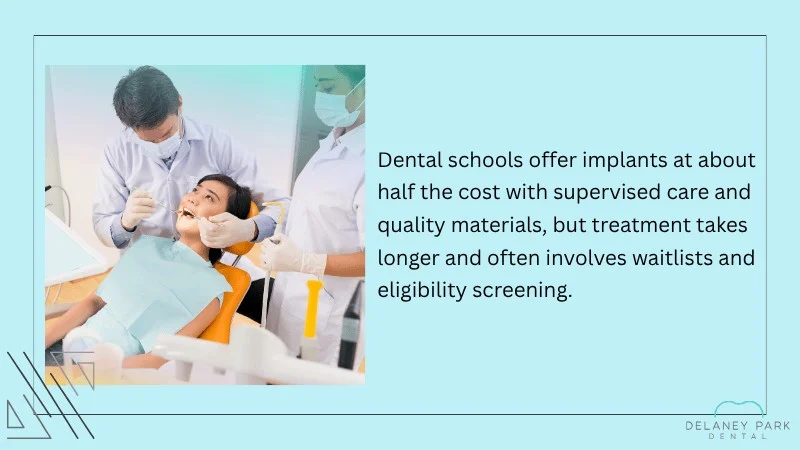
Dental schools offer discounted services to the public with savings of around 50% compared to private practices. Dental students perform the procedures under direct supervision from licensed dentists and oral surgeons.
The treatment takes longer than a regular dental office because instructors check each step of the process. However, this extra supervision ensures students follow proper protocols exactly.
You’ll receive the same quality materials and implant components used in standard practices.
Most dental schools have waiting lists for implant procedures due to high demand. You’ll need to schedule consultations several months in advance.
The schools screen patients to find cases that match their educational needs, so not everyone qualifies for treatment.
Nonprofit and Charitable Dental Programs
The Dental Lifeline Network connects volunteer dentists with people who have disabilities, medical issues, or are elderly and cannot afford dental care.
This organization provides free dental services, including implants, to qualifying patients.
Cosmetic Dentistry Grants is a nonprofit that awards grants for dental procedures twice per year. You apply by submitting your story and explaining why you need dental work.
Winners receive partial or full coverage for their treatment.
Some programs receive government grants to fund reduced-cost implants for low-income families, though completely free care is rare.
You’ll typically need to provide proof of income and demonstrate financial hardship to qualify for these programs.
Worried about the price tag? Stop by our office in Anchorage, AK, for a chat about smart payment solutions. We’ll help you map out a plan that works for your wallet and your smile.
Using Health Savings Accounts and Flexible Spending Accounts
Both HSAs and FSAs let you set aside pre-tax money to pay for dental implants and related procedures. These accounts can reduce your overall costs by 20-30% depending on your tax bracket.
How HSAs and FSAs Work for Dental Procedures
A health savings account is available if you have a high-deductible health plan. You contribute pre-tax dollars that you can use for qualified medical and dental expenses.
The money in your HSA rolls over year after year, so you never lose what you save.
A flexible spending account is an employer-sponsored benefit that works differently. You set aside pre-tax money during the plan year to cover eligible healthcare expenses.
Most FSAs follow a “use-it-or-lose-it” rule, which means unused funds typically don’t carry over to the next year.
Dental implants are generally eligible expenses when they’re medically necessary to restore function or manage oral health conditions.
This includes implant placement, extractions, bone grafting, X-rays, and anesthesia related to your surgery. You can use both accounts to cover out-of-pocket costs that insurance doesn’t reimburse.
Maximizing Pre-Tax Benefits
If you’re planning dental implant treatment, contribute the maximum amount allowed to your account each year. Setting aside funds gradually makes large procedures easier to afford without a major financial impact all at once.
2026 Contribution Limits:
- HSA: Up to $4,300 for individual coverage, $8,550 for family coverage
- FSA: Up to $3,200 per year
You can combine your HSA or FSA funds with insurance reimbursements and financing options. This layered approach helps cover the full cost of treatment while maximizing your tax savings.
Some dental providers accept HSA or FSA debit cards directly at the time of service. If not, you can pay out of pocket and submit an itemized statement to your account administrator for reimbursement.
Rules and Restrictions to Know
Only medically necessary dental procedures qualify for HSA and FSA reimbursement. Purely cosmetic treatments like teeth whitening or veneers won’t be covered.
You need to maintain a high-deductible health plan to stay eligible for HSA contributions. FSA eligibility depends on your employer offering this benefit option.
Check with your account administrator before scheduling treatment to confirm which specific procedures qualify. Different administrators may have slightly different rules about what counts as eligible.
Keep all receipts and treatment documentation in case you need to verify expenses later.
Ready to invest in yourself? Skip the paperwork and jump straight to affordable implant options. Complete our online form and take the first step toward a payment plan you can actually say yes to.
Tips for Finding the Best Dental Implant Financing Option
Finding the right way to pay for dental implants takes research and comparison. You’ll need to look at interest rates, check if you qualify, and talk to your dentist about lowering costs.
Comparing Lenders and Payment Terms
You should compare multiple financing options before choosing one. Look at the annual percentage rate (APR), which can range from 0% promotional rates to over 25% for some medical credit cards.
Check the monthly payment amounts and total repayment period. Some lenders offer terms as short as 3 months, while others extend up to 60 months.
Longer terms mean smaller monthly payments but more interest paid over time.
Watch out for hidden fees like origination charges or prepayment penalties. Ask about deferred interest promotions where you must pay the full balance by a deadline or face backdated interest charges.
Calculate the total cost including all fees and interest. A loan with a lower interest rate but high fees might cost more than one with slightly higher interest but no extra charges.
Checking Eligibility and Credit Requirements
Different dental financing options accept various credit scores. Medical credit cards and traditional personal loans typically require good to excellent credit scores above 650.
Buy now, pay later services and some specialized dental lenders approve patients with limited or poor credit history. These options often don’t require hard credit checks during the application process.
Review the maximum loan amounts available. Most lenders for dental work offer between $1,000 and $50,000, depending on your creditworthiness and the type of financing.
Check if you need a co-signer if your credit isn’t strong enough. Having someone with better credit co-sign can help you qualify for better rates and higher amounts.
Negotiating Costs With Your Dentist
Ask your dentist about payment plans or financing options they offer directly. Many dental offices provide in-house payment plans with lower or no interest for 6 to 12 months.
Request a detailed breakdown of all costs, including the implant post, abutment, crown, and any additional procedures like bone grafting. This helps you understand where you might reduce expenses.
Inquire about seasonal promotions or bundled treatment discounts. Some practices offer reduced rates during certain times of the year or when you combine multiple procedures.
Ask if the office offers free consultations to get a complete treatment estimate before committing. You can use this estimate to shop around and compare total costs between different dental practices in your area.
Making Dental Implants More Affordable: Proactive Steps
Taking control of your finances before starting treatment can significantly reduce the burden of paying for dental implants without insurance.
Smart planning around timing, budget adjustments, and daily spending habits creates real opportunities to save thousands of dollars.
Budgeting and Preparing for Treatment
Start by getting detailed price quotes from at least three different dental providers in your area. Ask each office to break down costs for the consultation, imaging, surgery, abutment, and crown separately.
This helps you understand exactly where your money goes.
Create a dedicated savings account specifically for your dental implant fund. Set up automatic transfers from each paycheck, even if it’s just $50 or $100 at a time.
Small, consistent contributions add up faster than you might expect.
Track your current spending for one month to identify areas where you can cut back.
Look at subscription services, dining out, and entertainment expenses. Redirecting just $200 per month into your dental savings could give you $2,400 in a year.
Consider opening a Health Savings Account (HSA) if your health insurance plan qualifies.
You can contribute pre-tax dollars and use them for dental implant financing, effectively reducing your costs by your tax bracket percentage.
Timing Your Procedure Strategically
Some dental offices offer discounts during slower months, typically January through March. Call and ask if your provider has seasonal promotions or reduced rates for scheduling during specific times.
If you need multiple implants, discuss with your dentist whether you can space them out over different calendar years.
This approach lets you use FSA or HSA funds across multiple benefit periods and makes payments more manageable.
Avoid rushing into treatment during financial emergencies or right before major life expenses like buying a home.
The stress of managing multiple financial commitments at once can lead to missed payments or higher interest charges.
Ask your dentist about bundling procedures.
Getting multiple implants done in one surgical appointment often costs less than scheduling separate surgeries, since you only pay for anesthesia, facility fees, and imaging once.
Lifestyle Changes and Saving Strategies

Review your daily coffee or lunch habits. Bringing lunch from home five days a week instead of buying it could save $150 monthly. Skip one $5 coffee per day and you’ll bank another $150 each month.
Sell items you no longer need on online marketplaces. Electronics, furniture, clothing, and hobby equipment can generate hundreds or thousands of dollars for your dental fund.
Take on a temporary side job or freelance work specifically to fund your implants. Driving for rideshare services, tutoring, or weekend retail work provides extra income without requiring a long-term commitment.
Consider these additional effective ways to get affordable dental implants:
- Ask family members to contribute to your dental fund instead of giving holiday or birthday gifts
- Use cashback credit cards for regular purchases and direct rewards to your savings
- Participate in paid research studies or focus groups
- Negotiate a raise at work and allocate the increase directly to your dental savings
Anchorage neighbors: You don’t need insurance to afford the smile you deserve. Ask us about local financing options that make dental implants more affordable, right here at Delaney Park Dental Clinic.
Frequently Asked Questions
Even without traditional insurance, you have multiple paths to affordable dental implants through payment plans, special financing programs, and alternative funding sources.
Many options work for people with less-than-perfect credit or limited financial resources.
What options are available for financing dental implants with bad credit?
You can still get financing even with bad credit. Buy Now, Pay Later services like Cherry offer approval rates over 80% and don’t require perfect credit scores.
Many BNPL platforms accept borrowers with limited or poor credit history. You might also qualify for credit union loans if you’re a member, as these institutions often have more flexible approval standards than big banks.
Dental savings plans are another option that require no credit check. You pay an annual membership fee and get discounted rates on procedures throughout the year.
Are there dental financing plans available without a credit check?
Yes, several financing options don’t require hard credit checks. Cherry’s dental financing uses a soft credit check that won’t hurt your credit score during the application process.
Dental savings plans and discount memberships never check your credit. You simply pay the membership fee and start using the discounts right away.
Some dental offices offer in-house payment plans that may not require traditional credit checks. These plans let you work directly with the practice to set up a payment schedule.
Can I find in-house payment plans for dental implants at dental clinics?
Many dental offices create their own payment plans that let you pay over time directly to the practice. These plans typically offer 3, 6, or 12-month payment options with low or no interest.
In-house plans are often customizable based on your budget. You’ll need to ask your dentist what options they provide since each practice sets its own terms.
The biggest benefit is that you avoid third-party lenders entirely. Just make sure you understand the payment terms and what happens if you miss a payment.
Which dental financing companies offer the best options for implants?
Several companies specialize in dental financing with different benefits. Cherry provides up to $50,000 in funding with true 0% APR for qualified borrowers and approval decisions in under 60 seconds.
CareCredit is a medical credit card option that many dental offices accept. They offer promotional interest-free periods if you pay off the balance within the specified timeframe.
LendingClub and LendingUSA offer personal loans specifically for dental work. These installment loans give you fixed monthly payments over extended terms.
How can I access government loans or grants for dental work?
Direct government loans for dental implants are extremely limited. Most government programs focus on basic dental care rather than cosmetic or elective procedures.
Nonprofits like Dental Lifeline Network provide free or low-cost treatment for eligible patients with disabilities or chronic illnesses. You’ll need to apply and meet their specific criteria.
If you’re employed, check if your company offers a Medical Expense Reimbursement Plan (MERP) or Health Reimbursement
Arrangement (HRA). These employer-funded programs can reimburse you for dental costs after you submit receipts.
Is it possible to arrange guaranteed financing for dental procedures?
No legitimate financing is truly “guaranteed” for everyone. Lenders must evaluate your ability to repay before approving any loan or credit line.
However, some options have very high approval rates. BNPL services approve over 80% of applicants and work with people across different credit backgrounds.
Dental savings plans are the closest to guaranteed since they don’t involve borrowing money. You pay the membership fee upfront and automatically qualify for discounted rates at participating dentists.