Skip to content




When a tooth is damaged by decay or a fracture, you might assume a full crown is your only option.
However, inlays and onlays vs crowns are often smarter choices because they preserve more of your natural tooth structure while still providing strong, long-lasting repairs.
These dental restorations fix moderate damage without the extensive tooth reduction that crowns require.
The key difference comes down to coverage. Inlays fit inside the grooves of your tooth between the cusps, while onlays extend over one or more cusps to protect weakened areas.
Crowns cover the entire visible portion of your tooth above the gumline. Choosing between inlays and onlays depends on how much healthy tooth structure remains and the extent of the damage.
Understanding when a smaller repair works just as well as a crown can save you time, money, and preserve more of your natural tooth.
This guide will help you understand which restoration is right for your situation and what to expect during treatment.
Key Takeaways
- Inlays and onlays preserve more natural tooth structure than crowns by only replacing damaged areas instead of covering the entire tooth
- The right restoration choice depends on how much of your tooth remains healthy and the location of the damage
- Modern materials like porcelain and zirconia provide strength and natural appearance for all three types of restorations
Table of Content
- Fundamental Differences Between Inlays, Onlays, and Crowns
- When to Choose Inlays or Onlays Instead of Crowns
- Materials, Strength, and Aesthetics
- Treatment Steps and What to Expect During the Procedure
- Aftercare and Oral Hygiene for Long-Lasting Results
- Frequently Asked Questions
Fundamental Differences Between Inlays, Onlays, and Crowns
The main difference between these restorations comes down to how much of your tooth they cover and protect.
Inlays fit inside the tooth, onlays extend over one or more cusps, and crowns cover the entire visible portion of your tooth.
How Each Restoration Covers the Tooth
An inlay works like a custom-made filling that fits between the cusps of your tooth. These cusps are the raised points on your chewing surface. Your dentist uses inlays when decay or damage stays within these boundaries.
Onlays cover a larger area than inlays. They restore the inner portion of your tooth and extend over at least one cusp. Think of onlays as a protective cap that covers part of your tooth’s chewing surface.
A full crown covers your entire tooth above the gum line. It acts like a protective shell that surrounds all sides of your tooth. Crowns provide the most coverage when restoring damaged teeth that need complete protection.
Defining Partial and Full Crowns
Full-coverage crowns wrap around your entire tooth structure. Your dentist shapes the tooth on all sides to make room for the crown material.
Partial crowns refer to onlays in some dental practices. These restorations cover part of your tooth but don’t go all the way around like a full crown does.
The term can be confusing because many dentists simply call them onlays or dental onlays.
The key distinction is coverage area. Full crowns require more reshaping of your natural tooth than partial crowns or onlays do. This means you keep more of your original tooth structure with partial coverage options.
Indirect vs Direct Restorations
Inlays and onlays are indirect restorations. Your dentist takes impressions of your tooth and sends them to a lab. A technician creates your custom restoration outside of your mouth.
You’ll need a temporary restoration while waiting for the permanent one.
Direct restorations get placed during a single visit. Your dentist shapes the material directly in your mouth and hardens it with a special light. Regular fillings use this method.
Dental crowns are also indirect restorations in most cases. A lab creates your crown based on impressions or digital scans.
Some dental offices now offer same-day crowns using special milling machines.
Even though these get made on-site, they still follow the indirect restoration process because a computer designs them before they’re placed in your mouth.



When to Choose Inlays or Onlays Instead of Crowns
The choice between inlays and onlays vs crowns depends on how much of your tooth is damaged and how much healthy structure remains.
Smaller repairs often work better when you have enough good tooth material left to support them.
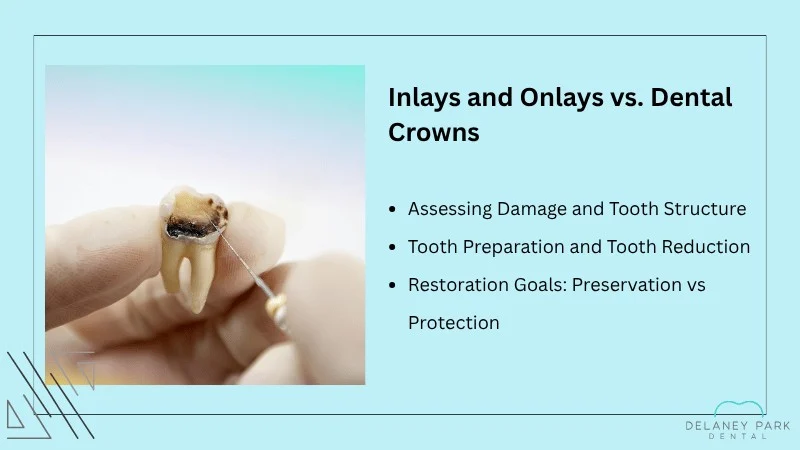
Assessing Damage and Tooth Structure
Your dentist will look at where the damage is located on your tooth. An inlay works well when decay sits between the tooth cusps, which are the raised points on your chewing surface.
When damage extends to one or more tooth cusps, an onlay becomes the better option.
Fractured cusps often need coverage that an onlay provides without going as far as a full crown.
If your tooth has good structure at the gum line and most of the outer walls are intact, you’re a good candidate for these smaller repairs.
A crown becomes necessary when decay or damage affects most of your tooth structure. This includes situations where you’ve had multiple fillings fail or when secondary decay has spread under old dental work.
Your dentist will also check if the damage goes below the gum line, which usually means you need a crown for proper protection.
Tooth Preparation and Tooth Reduction
Tooth preparation varies significantly between these options. Inlays and onlays require minimal tooth reduction because they only cover the damaged areas.
Your dentist removes the decay and shapes just enough tooth structure to fit the restoration.
Crowns need more tooth reduction all around. Your dentist must file down the entire tooth to make room for the crown to fit over it. This means losing more healthy tooth material that you can never get back.
Conservative dentistry focuses on keeping as much natural tooth as possible. When your situation allows it, choosing an inlay or onlay preserves more of your original tooth structure.
This approach gives you more options if you need additional dental work later in life.
Restoration Goals: Preservation vs Protection
Tooth preservation should guide your decision when you have enough healthy structure remaining. Inlays and onlays let you keep the strong outer walls of your tooth, which helps it stay stable for years to come.
Protection becomes the priority when your tooth is severely weakened. A crown covers and holds together a severely damaged or decayed tooth that might otherwise crack or break.
This is especially important for back teeth that handle heavy chewing forces.
Consider your long-term dental health too. If you’re younger, preserving tooth structure gives you more options for future repairs.
If you have a history of teeth grinding or clenching, a crown might provide better durability even if an onlay could technically work.
Materials, Strength, and Aesthetics
The material you choose for your inlay, onlay, or crown affects how natural it looks, how long it lasts, and how well it handles chewing forces.
Modern dental restorations use advanced ceramics, durable composites, and traditional metals, each with distinct advantages for different situations.
Comparing Ceramic, Composite, and Metal Options
Ceramic materials offer the most natural appearance and blend seamlessly with your tooth enamel. A ceramic onlay can replicate the translucency and color of real teeth better than other options.
Composite resin inlays cost less and require less tooth removal. They can be made in a single visit and adjusted easily. However, they may stain over time and don’t last as long as ceramic options.
Metal restorations, typically gold or metal alloys, provide exceptional strength and durability. They resist wear extremely well and rarely break.
The downside is their obvious appearance, which makes them less popular for visible teeth.
| Material Type | Appearance | Durability | Best Use |
| Ceramic | Excellent | High | Front and back teeth |
| Composite | Good | Moderate | Conservative repairs |
| Metal | Poor | Very High | Back molars only |
Role of Lithium Disilicate and High-Tech Ceramics
Lithium disilicate, commonly known as e.max, has become a top choice for dental onlays and inlays. This material combines strength with excellent aesthetics, making it suitable for both front and back teeth.
High-strength ceramics like zirconia work well for areas that experience heavy chewing forces. Zirconia is stronger than lithium disilicate but slightly less translucent.
This makes it ideal for back molars where strength matters more than perfect color matching.
These advanced ceramics bond tightly to your natural tooth structure. This bonding strengthens both the restoration and your remaining tooth.
The materials also resist staining from coffee, tea, and other foods better than composite options.
Lithium disilicate can be layered and customized to match your exact tooth shade. This level of customization helps your restoration disappear among your natural teeth.
Durability, Longevity, and Bite Forces
Your back teeth can generate bite forces up to 200 pounds during chewing. The material you choose needs to handle this repeated stress without cracking or wearing down.
Studies show that e.max onlays and overlays last 10 years or longer when properly bonded. Metal restorations can last 15 to 20 years but lack aesthetic appeal. Composite resin inlays typically need replacement after 5 to 7 years.
Zirconia restorations provide maximum durability for patients who grind their teeth. The material distributes bite forces evenly and resists fractures better than other options.
If you have a dental implant nearby, zirconia won’t cause excessive wear on opposing teeth.
Ceramic materials perform best when supported by healthy tooth structure. Your dentist will consider how much natural tooth remains when recommending a material.
Weaker teeth may need the full coverage of a crown rather than a smaller restoration.
Treatment Steps and What to Expect During the Procedure
Getting an inlay, onlay, or crown involves two appointments at your dental clinic.
Your dentist will prepare your tooth, take impressions for the dental laboratory, and place a temporary restoration while your permanent one is made.
Initial Consultation and Treatment Planning
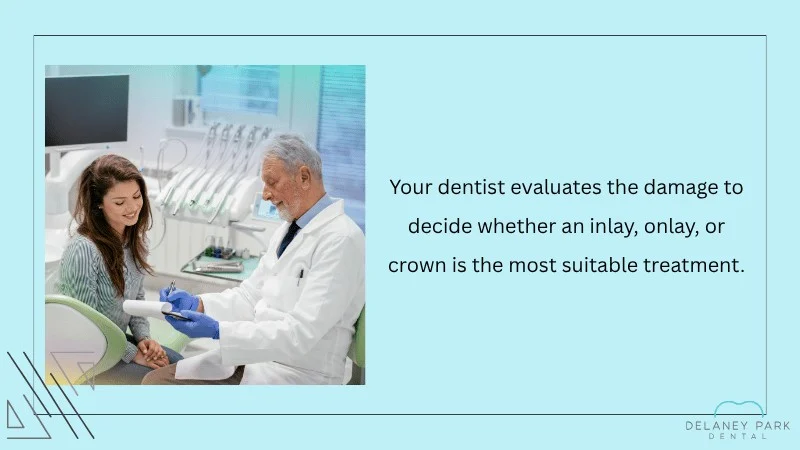
Your dentist will examine your tooth and take X-rays to assess the damage. They’ll explain whether an inlay, onlay, or crown is the best option for your situation.
During treatment planning, your dentist considers how much healthy tooth structure remains. If decay stays within the cusps, an inlay works well.
When damage extends over one or more cusps, an onlay becomes necessary.
For severely damaged teeth, crown treatment may be recommended instead. Your dentist will discuss material options like porcelain, gold, composite resin, or zirconia based on your needs and budget.
They’ll also explain the timeline, which typically spans two weeks between appointments.
Impression, Fabrication, and Laboratory Roles
At your first visit, your dentist numbs the area and removes all decay. They’ll shape your tooth to create space for the indirect restoration using specialized dental burs.
After preparing the tooth structure, your dentist takes impressions of your tooth. They might use traditional putty-like material or a digital scanner to capture precise measurements.
These impressions go to a dental laboratory where skilled technicians fabricate your custom restoration.
The lab creates your inlay, onlay, or crown to match your tooth’s exact shape and color. This process usually takes one to two weeks. Your dentist places a temporary restoration to protect your prepared tooth while you wait.
Placement, Adjustments, and Temporary Restorations
Your temporary restoration protects your tooth but isn’t as strong as the final one. Avoid chewing sticky or hard foods on that side until your permanent restoration is placed.
At your second appointment, your dentist removes the temporary and cleans your tooth thoroughly. They’ll try in your new indirect restoration to check the fit and bite.
If adjustments are needed, your dentist carefully shapes the restoration using fine polishing tools.
Once the fit is perfect, they bond the restoration using dental cement. For ceramic restorations, special bonding agents strengthen the attachment.
Your dentist checks your bite with thin paper and makes final adjustments so you can chew comfortably.
Aftercare and Oral Hygiene for Long-Lasting Results
Taking care of your dental restoration properly helps it last many years and protects your tooth from future problems.
Good daily habits and knowing when to call your dentist make all the difference in how well your inlay, onlay, or crown holds up over time.
Tips for Maintaining Your Restorations
Your oral hygiene routine needs to stay consistent after getting any type of dental restoration. Brush your teeth twice daily with fluoride toothpaste and floss once every day.
Pay special attention to the area where your restoration meets your natural tooth, as this is where plaque builds up most easily.
Secondary decay often starts at the edges of dental restorations when you don’t clean thoroughly. Use gentle circular motions when brushing around your restoration.
Floss carefully between teeth to remove food particles and bacteria that cause decay.
Avoid chewing ice, hard candy, or other very hard foods that can crack or damage your restoration. If you grind your teeth at night, ask your dentist about a night guard to protect your investment.
Visit your dentist every six months for professional cleanings and checkups. These regular visits let your dentist spot small problems before they become big issues.
With proper care, inlays and onlays can last 10 to 15 years or more, and crowns often last 15 years or beyond.
Recognizing Complications and When to Seek Help

Consult your dentist right away if you feel pain or sensitivity around your restoration that lasts more than a few days.
Some mild sensitivity is normal right after the procedure, but ongoing discomfort means something needs attention.
Watch for these warning signs:
- Sharp pain when biting down
- The restoration feels loose or moves slightly
- Swelling or tenderness in your gums near the restoration
- A bad taste or odor coming from the area
- Visible cracks or chips in the restoration
If you notice any gaps forming between your restoration and your tooth, schedule an appointment quickly. Bacteria can enter these spaces and cause decay underneath your dental restoration.
Contact your dentist immediately if your restoration falls out completely. Keep the piece if possible and bring it to your appointment.
Don’t wait to address problems, as early intervention prevents more extensive damage that might require a more invasive treatment later.
Frequently Asked Questions
Choosing the right restoration depends on how much tooth damage exists and what goals you have for your dental health. These answers help explain when each option makes sense.
How do dentists decide whether an inlay, onlay, or crown is the best option for a damaged tooth?
Your dentist looks at how much healthy tooth structure remains after removing decay or damage. If the damage stays within the grooves of your tooth’s chewing surface, an inlay usually works well.
When damage extends over one or more of the raised points on your tooth (called cusps), an onlay becomes the better choice.
Dentists recommend crowns when most of the tooth structure is gone or the tooth is severely weakened.
Your dentist also considers the location of the tooth and how much force it handles when you chew. Back teeth that do heavy chewing work may need stronger protection than front teeth.
What’s the difference between an inlay and an onlay, and when would each one be used?
An inlay fits inside the natural grooves of your tooth without covering the cusps. It works like a puzzle piece that fills the space where decay or damage was removed.
An onlay covers one or more cusps and extends over a larger portion of the chewing surface. You can think of it as a partial crown that protects more of the tooth.
Inlays are used when cavities or fractures stay confined to the center of the tooth. Onlays handle more extensive damage that reaches the outer edges.
Is an inlay or onlay a good choice if my tooth has a large filling that keeps failing?
Yes, inlays and onlays often solve the problem of failing fillings. Large fillings can crack or pull away from the tooth over time because they don’t distribute chewing forces evenly.
An inlay or onlay is custom-made to fit your tooth exactly and bonds more securely to the tooth structure. This creates a tighter seal that helps prevent bacteria from getting underneath.
These restorations are much stronger than composite fillings and can handle the pressure from chewing without breaking down. They reinforce the remaining tooth structure instead of just filling a hole.
How much natural tooth structure can be saved with an inlay or onlay compared to a crown?
Crowns require your dentist to remove tooth structure from all sides of the tooth to create space for the restoration to fit over it. This means healthy enamel gets ground down even in areas that aren’t damaged.
Inlays and onlays only require removal of the damaged portion of the tooth. The dentist preserves as much healthy enamel as possible while still providing strong protection.
Keeping more of your natural tooth is better for long-term dental health. Natural tooth structure is stronger than any dental material, so saving it helps your tooth last longer.
How long do inlays and onlays typically last, and how does that compare with crowns?
Inlays and onlays can last 10 to 30 years with proper care. Ceramic versions have a 10-year success rate of up to 83.6%, while gold onlays are even more durable.
Crowns also last 10 to 30 years on average, so both options offer similar longevity. The actual lifespan depends on the material used, where the tooth is located, and how well you care for it.
Your daily habits make a big difference in how long any restoration lasts. Brushing and flossing daily, avoiding chewing ice or hard objects, and wearing a nightguard if you grind your teeth all help protect your restoration.
What should I expect during the procedure and recovery for an inlay/onlay versus a crown?
The procedures are very similar for both options. Your dentist removes the damaged tooth structure and takes either a digital scan or traditional impression of your tooth.
If your restoration is made in a dental lab, you’ll need two visits about one to two weeks apart. A temporary restoration protects your tooth between appointments.
Some dental offices use CEREC technology to make the restoration in one visit.
Recovery is about the same for inlays, onlays, and crowns. You might have mild sensitivity for a day or two, but most people return to normal eating right away.
The bonding process and final adjustments take the same amount of time regardless of which restoration you receive.